
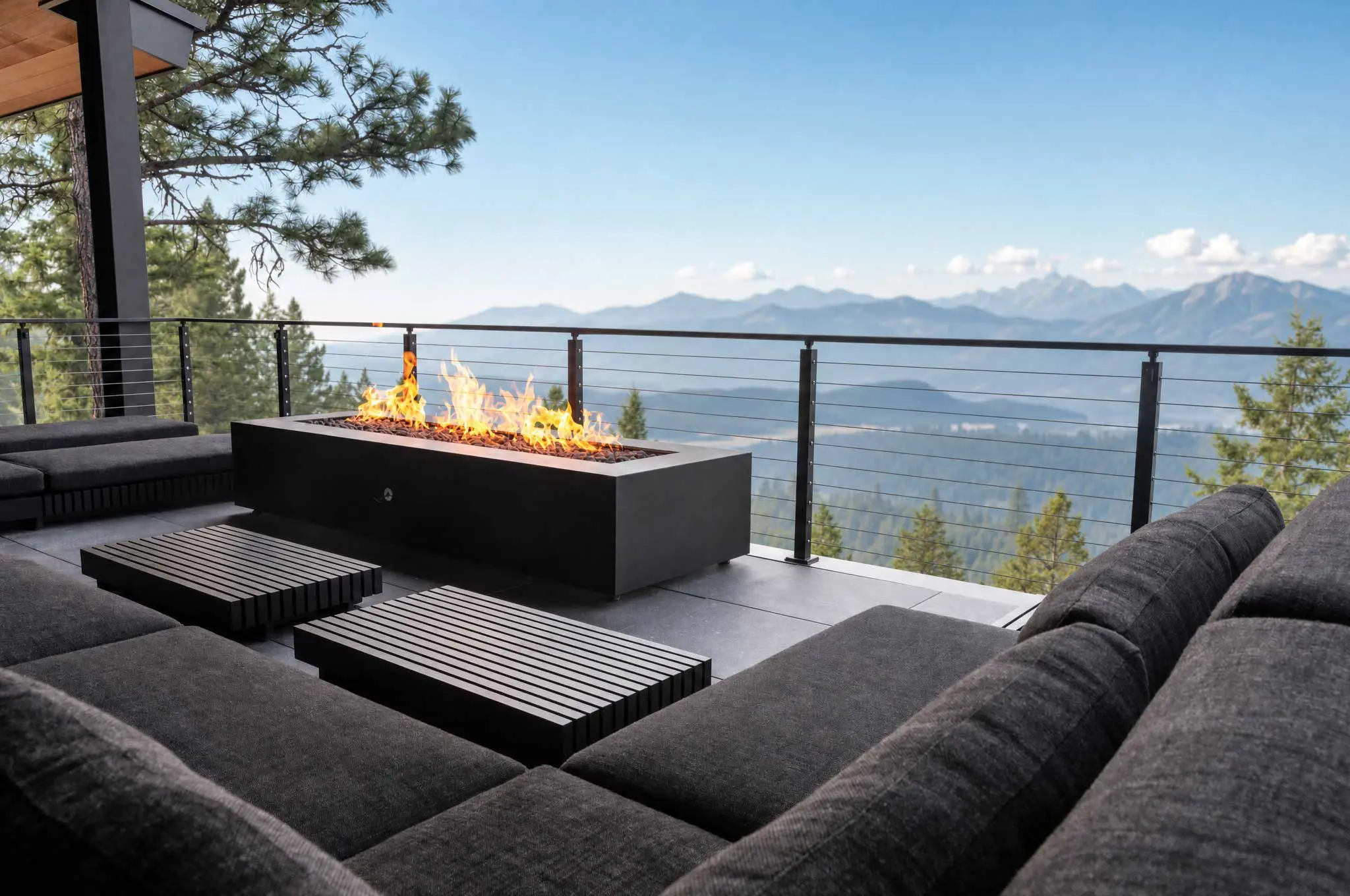
Gas Line Sizing for Gas Fire Pits and Fire Features
Gas Line Sizing Chart for Fire Features and Supporting Videos to Get Your Project Installed
Quick answer: Measure the gas line from your meter or propane tank to the fire pit, add 5 feet for every fitting, then find that length and your pipe size in the chart below. The number is how many thousand BTUs per hour the line can deliver. Your burner’s BTU rating should be at or below it. Example: a 374,000 BTU natural gas burner on a 30 ft run needs a 1″ line.
Start Your Fire Pit Plan with Gas Line Sizing
How to size your gas line
- Know your burner’s BTU rating. It’s listed on every Crossfire burner.
- Measure the run. Distance in feet from the gas meter or propane tank to the fire pit.
- Add 5 ft per fitting. Every elbow, tee and connector restricts flow.
- Add other appliances. If a grill, furnace or water heater shares the line, add their BTUs to your burner’s.
- Read the chart. Find your length (round up), then pick the smallest pipe size whose number is at or above your total BTUs (in thousands).
- Check pressure. Propane: 11–13″ water column. Natural gas: 7–10″ water column. Too high = loud “blowtorch” flames; too low = weak flames.
- Have a licensed gas pro confirm and install. Pipe material, supply pressure and local code all affect the final size.
Good news: Crossfire burners still give great flames at about 70% of their rated fuel. A 180K BTU burner on a line that delivers 150K will look great.
How to Read the Gas Line Sizing Chart
Natural gas pipe sizing chart
Inlet pressure less than 2 psi · 0.5″ w.c. pressure drop · specific gravity 0.60. Values in thousands of BTU per hour (1 cubic foot of natural gas ≈ 1,000 BTU).
| Length (ft) | ½″ | ¾″ | 1″ | 1¼″ | 1½″ | 2″ | 2½″ | 3″ | 4″ |
|---|---|---|---|---|---|---|---|---|---|
| 10 | 172 | 360 | 678 | 1,390 | 2,090 | 4,020 | 6,400 | 11,300 | 23,100 |
| 20 | 118 | 247 | 466 | 957 | 1,430 | 2,760 | 4,400 | 7,780 | 15,900 |
| 30 | 95 | 199 | 374 | 768 | 1,150 | 2,220 | 3,530 | 6,250 | 12,700 |
| 40 | 81 | 170 | 320 | 657 | 985 | 1,900 | 3,020 | 5,350 | 10,900 |
| 50 | 72 | 151 | 284 | 583 | 873 | 1,680 | 2,680 | 4,740 | 9,660 |
| 60 | 65 | 137 | 257 | 528 | 791 | 1,520 | 2,430 | 4,290 | 8,760 |
| 70 | 60 | 126 | 237 | 486 | 728 | 1,400 | 2,230 | 3,950 | 8,050 |
| 80 | 56 | 117 | 220 | 452 | 677 | 1,300 | 2,080 | 3,670 | 7,490 |
| 90 | 52 | 110 | 207 | 424 | 635 | 1,220 | 1,950 | 3,450 | 7,030 |
| 100 | 50 | 104 | 195 | 400 | 600 | 1,160 | 1,840 | 3,260 | 6,640 |
| 125 | 44 | 92 | 173 | 355 | 532 | 1,020 | 1,630 | 2,890 | 5,890 |
| 150 | 40 | 83 | 157 | 322 | 482 | 928 | 1,480 | 2,610 | 5,330 |
| 175 | 37 | 77 | 144 | 296 | 443 | 854 | 1,360 | 2,410 | 4,910 |
| 200 | 34 | 71 | 134 | 275 | 412 | 794 | 1,270 | 2,240 | 4,560 |
| 250 | 30 | 63 | 119 | 244 | 366 | 704 | 1,120 | 1,980 | 4,050 |
| 300 | 27 | 57 | 108 | 221 | 331 | 638 | 1,020 | 1,800 | 3,670 |
| 350 | 25 | 53 | 99 | 203 | 305 | 587 | 935 | 1,650 | 3,370 |
| 400 | 23 | 49 | 92 | 189 | 283 | 546 | 870 | 1,540 | 3,140 |
Propane (LP) pipe sizing chart
Low-pressure propane after regulation · 11″ w.c. inlet · 0.5″ w.c. pressure drop · specific gravity 1.50. Values in thousands of BTU per hour. Example: a 787,000 BTU burner on a 20 ft run needs a 1″ line.
| Length (ft) | ½″ | ¾″ | 1″ | 1¼″ | 1½″ | 2″ | 2½″ | 3″ | 4″ |
|---|---|---|---|---|---|---|---|---|---|
| 10 | 291 | 608 | 1,150 | 2,350 | 3,520 | 6,790 | 10,800 | 19,100 | 39,000 |
| 20 | 200 | 418 | 787 | 1,620 | 2,420 | 4,660 | 7,430 | 13,100 | 26,800 |
| 30 | 160 | 336 | 632 | 1,300 | 1,940 | 3,750 | 5,970 | 10,600 | 21,500 |
| 40 | 137 | 287 | 541 | 1,110 | 1,660 | 3,210 | 5,110 | 9,030 | 18,400 |
| 50 | 122 | 255 | 480 | 985 | 1,480 | 2,840 | 4,530 | 8,000 | 16,300 |
| 60 | 110 | 231 | 434 | 892 | 1,340 | 2,570 | 4,100 | 7,250 | 14,800 |
| 80 | 101 | 212 | 400 | 821 | 1,230 | 2,370 | 3,770 | 6,670 | 13,600 |
| 100 | 94 | 197 | 372 | 763 | 1,140 | 2,200 | 3,510 | 6,210 | 12,700 |
| 125 | 89 | 185 | 349 | 716 | 1,070 | 2,070 | 3,290 | 5,820 | 11,900 |
| 150 | 84 | 175 | 330 | 677 | 1,010 | 1,950 | 3,110 | 5,500 | 11,200 |
| 175 | 74 | 155 | 292 | 600 | 899 | 1,730 | 2,760 | 4,880 | 9,950 |
| 200 | 67 | 140 | 265 | 543 | 814 | 1,570 | 2,500 | 4,420 | 9,010 |
| 250 | 62 | 129 | 243 | 500 | 749 | 1,440 | 2,300 | 4,060 | 8,290 |
| 300 | 58 | 120 | 227 | 465 | 697 | 1,340 | 2,140 | 3,780 | 7,710 |
| 350 | 51 | 107 | 201 | 412 | 618 | 1,190 | 1,900 | 3,350 | 6,840 |
| 400 | 46 | 97 | 182 | 373 | 560 | 1,080 | 1,720 | 3,040 | 6,190 |
Download the printable gas pipe sizing chart
Use these charts as a guideline only. They don’t account for pipe material (black iron vs. CSST), other appliances, meter pressure or fittings. Montana Fire Pits and Warming Trends are not licensed gas professionals. Consult a local gas professional to determine your actual BTU availability.
Parts for your gas line
- Crossfire brass burners (sized from 60K to 470K BTU)
- Flex line and key valve kits
- Fire pit planning guide: choosing BTUs
- Natural gas vs. propane