
Most fire feature failures trace back to a decision made too late, a specification left too vague, or a component swapped out by the contractor to save two hundred dollars. The checklist below exists because those outcomes are avoidable, and because the landscape architects who consistently deliver excellent fire features work from a systematic approach.
Specifying a fire feature is not complicated. But it requires asking the right questions at the right phase, and holding the answers through every subsequent decision. That discipline is what separates a fire feature that performs reliably for years from one that becomes a callback.
1. Lock In The Fire Feature Decision At Schematic Phase
The single most common specification error is treating the fire feature as a finish selection. It is not. It is infrastructure. By the time you are finalizing paving patterns and plant schedules, the window for meaningful fire feature decisions has largely closed.
The fuel source, BTU output, ignition type, and overall feature dimensions must be determined during schematic design, ideally before the hardscape layout is finalized. A gas line routed in the wrong direction, a fire pit set in a location without conduit access for an ignition system, a seating wall dimensioned without accounting for burner clearances, these are costly corrections. They are also entirely preventable.
Treat the fire feature the way you would treat a water feature or an outdoor kitchen: as a system that requires coordination with civil, MEP, and structural elements early in the process. Set it on the schedule accordingly.
2. Fuel Type Determines Infrastructure, Choose Before Design Development
Natural gas and propane are not interchangeable on paper. Choosing between them commits you to a specific infrastructure path, and that path needs to be coordinated before Design Development is complete.
Natural gas connects to the municipal supply, requires coordination with the utility provider, and eliminates the need for on-site tank storage. For urban and suburban projects with existing gas service, it is typically the cleaner specification. Propane requires a storage tank, above ground or buried, and a dedicated feed line sized to the BTU demand of all appliances drawing from it. On rural sites, or where utility connection is cost-prohibitive, propane is often the correct answer. But the tank location, screening, and access must be accounted for in the site plan.
Both fuel types have different orifice sizing requirements. A burner specified for natural gas cannot be run on propane without conversion, and vice versa. Confirm the fuel type with the client before specifying the burner, and document it clearly in the spec. A contractor who swaps fuel types mid-project is creating a safety issue, not saving cost.
3. Ignition System Type Is a User Experience Decision
There are two primary ignition approaches: match-lit and electronic. Automation, whether through remote control, smart home integration, or app-based control, is a layer that sits on top of electronic ignition rather than a category of its own. Each approach represents a different user experience, a different installation requirement, and a different maintenance profile.
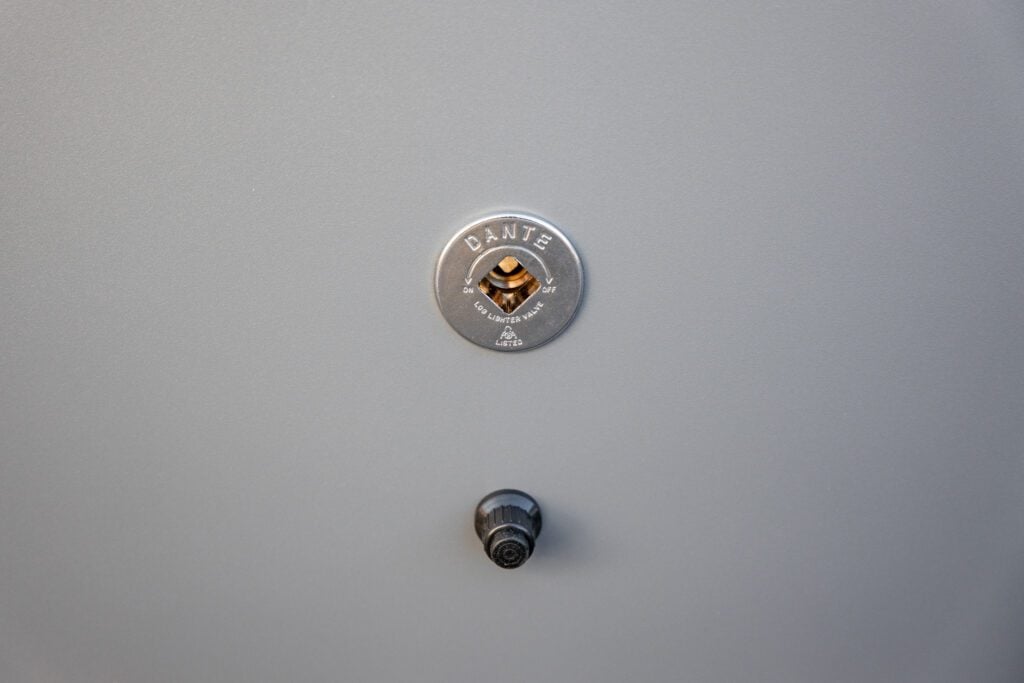
Match-lit systems use a manual key valve to control gas flow. The user turns the key to release gas, introduces a flame to light the burner, and adjusts flame height with the same valve. This is the simplest and least expensive approach, appropriate for fire bowls and simpler applications where budget is constrained and the client understands the tradeoff.
Electronic ignition eliminates the manual lighting step. A push-button or spark ignition system lights the burner on demand, which makes it the right specification for most designed outdoor environments and the only real path if automation is part of the project scope. When an electronic system is specified, electrical conduit must be planned at schematic phase, not after the hardscape is set.
Confirm that the ignition system is compatible with both the burner and the fuel type. A mismatch creates installation delays and, in some cases, safety issues.
4. Clearance-To-Combustibles and code compliance are non-negotiable
Every jurisdiction has its own fire code requirements, and those requirements vary significantly. The International Fire Code provides a baseline, but local amendments, particularly in Wildland-Urban Interface (WUI) zones, can impose far stricter clearances, fuel restrictions, and permitting requirements.
Minimum clearances to combustibles are not design suggestions. They determine whether the fire feature can be located where you want it, whether the planting adjacent to it is appropriate, and whether the structure overhead clears the required separation distance. Call these clearances out on the drawing set rather than leaving them to contractor interpretation.
In WUI-designated areas, confirm with the local authority having jurisdiction (AHJ) whether open fire features are permitted at all, and under what conditions. Some jurisdictions restrict open burner pans and require enclosed fire pit designs. Others impose seasonal burn restrictions. Know this before schematic design, not after permit submission.
5. Burner system quality and wind performance are the specification that lasts
The burner specification is simpler than most architects expect, because the constraint is almost never which burner to choose, it is whether the gas line can support it. Specify the gas supply capacity first. The burner follows from that.
A properly engineered burner at any output level will produce a consistent, full flame. The difference between a smaller and larger BTU unit from a quality manufacturer is scale, not performance. You do not need the highest-output burner on the market to get an exceptional result. What you need is a burner that is matched to the gas pressure and volume available at the point of connection. Every complete fire feature system we build is engineered against this principle, which is why oversizing the burner relative to gas supply, the most common installation error, shows up immediately as a weak, lazy flame that has nothing to do with the product itself.
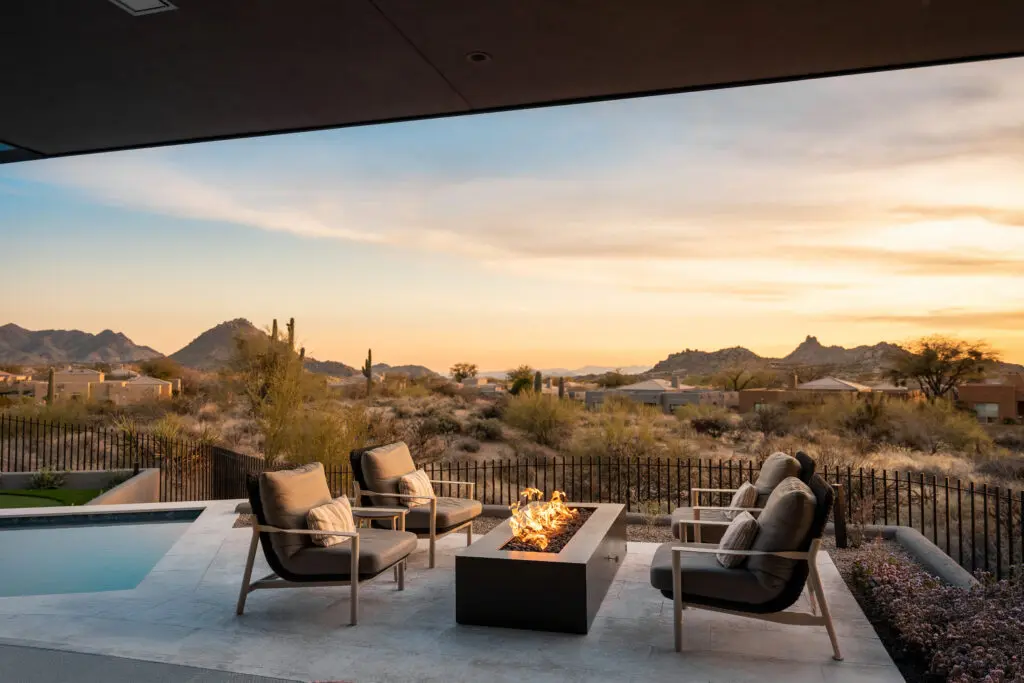
Site placement matters as much as output. The single best thing you can do for the performance of any fire feature is locate it out of the primary wind path. A burner in a sheltered courtyard will outperform a higher-BTU unit on an exposed terrace every time. If the design demands an exposed location, specify a wind guard and document it; do not rely on the burner to compensate for a siting problem.
A well-built burner at the right size, in the right location, on the right gas supply, performs without drama. That is what a designed space requires.
6. Drainage and water management
Every outdoor fire feature collects water. In the absence of a cover, rain and snowmelt pool in the burner pan, saturate the media (glass, lava rock, or ceramic logs), and over time accelerate corrosion at exactly the points where corrosion is most problematic. In cold climates, that water freezes and expands, which can crack burner components and compromise welds.
A specification that assumes the client will always cover the feature is a specification that fails. Clients travel, forget, and leave covers off for weeks at a time. Drainage must be engineered into the burner pan itself: a weep hole or drain port, sized appropriately, that allows water to exit before it becomes a problem.
If the fire feature is built into a hardscape, coordinate the drainage path with the surrounding stone or concrete. Water that exits the burner pan has to go somewhere. Plan for it.
7. Material and finish specification: the fire feature is part of the project palette
A fire feature specified in isolation from the broader project palette is a specification failure. The material, finish, and form of the fire feature should be resolved the same way you resolve any other built element, against the project’s material hierarchy, color range, and formal language.
Corten steel reads differently than powder-coated aluminum, which reads differently than cast concrete, which reads differently than stacked natural stone. The surround, the cap, and any visible housing material should be specified to integrate, not just coexist. Note the finish as precisely as you would specify a paving unit or a structural steel connection. Generic descriptions leave too much interpretation to the fabricator or installer.
For custom applications, verify lead times early. Custom fabrication can run six to eight weeks or longer. If the fire feature surround is a custom element, it needs to be on the procurement schedule the same way a custom gate or a specialty lighting fixture would be.
8. Manufacturer documentation belongs in the specification package
A fire feature that ships without complete documentation creates liability exposure for the landscape architect and confusion for the contractor. The documentation package should include installation instructions, clearance requirements, BTU ratings, maintenance schedules, and warranty terms. Request the full set before the product is specified, not after it arrives on site.
Manufacturers who support the specification community provide more than product data sheets. They offer CAD files, Revit families, submittal-ready documentation, and technical support through the installation process. The Montana Fire Pits Pro program was built around that principle: the goal is to give the specifier what they need to specify with confidence, not to treat landscape architects as an afterthought in the sales channel.
A final note on specification discipline
Fire has earned a place in the designed landscape as a primary architectural element, not an accessory, not an amenity upgrade, not an afterthought. The professionals who consistently deliver excellent fire features are the ones who treat specification as a discipline: locking in decisions early, documenting them precisely, and coordinating the system through to installation.
Montana Fire Pits works directly with landscape architects throughout the specification process, from preliminary product selection and documentation requests to submittal review and post-installation support. If you are specifying a fire feature and need a manufacturer that meets you where you are in the process, start a conversation with our Pro team.

What goes in the vessel: a guide to fire media
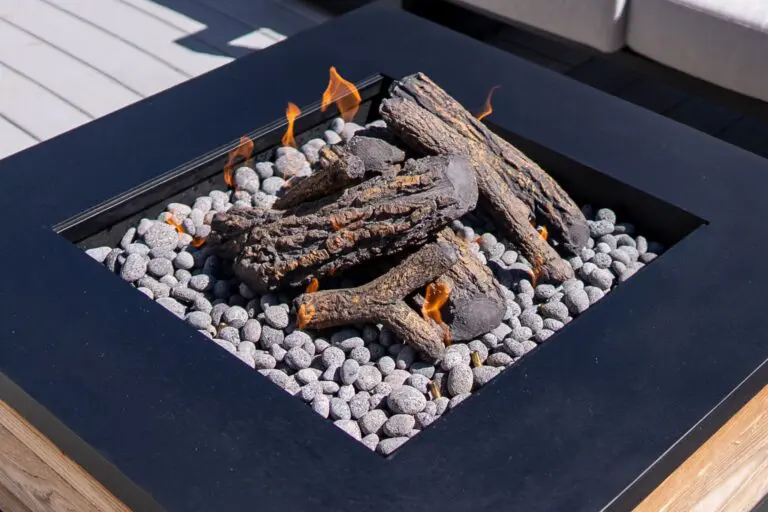
The burner makes the flame. The media is what you look at. Everything sitting in the vessel of a gas fire table,
Aluminum: the vessel material that earns its place
Fire features have become a standard expectation in premium outdoor design. Clients want them. Architects draw them in. And as the contractor, you’re the one who has to make the vision actually work — with real gas lines, real installation conditions, and a real client standing by.
The Yellowstone Edge Is Here
The Venture Series · 2026 Release The Yellowstone Edge does not ask for attention. This is the newest addition to The Venture